NEW ENGLAND · COMMERCIAL & INDUSTRIAL FLOORING
COMMERCIAL FLOORING GUIDE

Commercial Concrete Polishing: A Practical Guide for Industrial and Commercial Floors

An industrial and commercial flooring guide from New England Floor & Wall

Your concrete floor may be costing more to maintain than you realize.

Maybe the surface constantly produces dust no matter how often your maintenance crew cleans it. Perhaps an aging coating has started peeling, or years of heavy traffic have left your warehouse floor looking worn and difficult to maintain.

Before investing in another coating or replacing the floor entirely, there's an option worth exploring: commercial concrete polishing.

For a facility with suitable concrete, polishing produces a finished surface that is easier to clean while retaining the character of the original slab.

Of course, not every concrete floor is a good candidate. That's why understanding how polishing works, and where its limitations begin, matters before making an investment.

This guide explains what happens during polishing, how finish choices affect the result, what drives the cost, and when another flooring system may serve your building better.

What Is Commercial Concrete Polishing?

Think of the difference between a rough piece of natural stone and one that's been carefully polished. The material itself hasn't changed, but the surface looks and feels remarkably different.

Concrete polishing works on a similar principle.

Using specialized equipment fitted with diamond abrasives, contractors gradually grind and refine the concrete until it reaches the desired finish.

Depending on the slab and polishing system, contractors also apply a chemical densifier to improve surface hardness and abrasion resistance.

The finished surface ranges from a subtle satin appearance to a highly reflective polish, depending on the selected process.

Unlike epoxy flooring, which forms a separate resinous layer over prepared concrete, polished concrete remains the exposed surface of the original slab.

Explore New England Floor & Wall's polished concrete flooring services
Commercial concrete polishing Massachusetts

Why Do Commercial Property Owners Choose Polished Concrete?

For many facility managers, the attraction isn't simply having a better-looking floor. It's addressing problems that have become part of the building's everyday operation.

Less concrete dust to deal with

When a warehouse floor constantly produces fine gray dust, cleaning becomes a recurring frustration.

On a suitable slab, grinding and densification help reduce certain types of surface dusting by improving the concrete's resistance to abrasion.

A floor that's easier to keep clean

Rough or deteriorated concrete makes routine cleaning more difficult.

A properly polished surface is generally easier to maintain with suitable cleaning equipment and products. For a busy commercial facility, that means a more manageable cleaning routine.

A completely different appearance without covering the concrete

One of the most striking aspects of polished concrete is the change in its appearance.

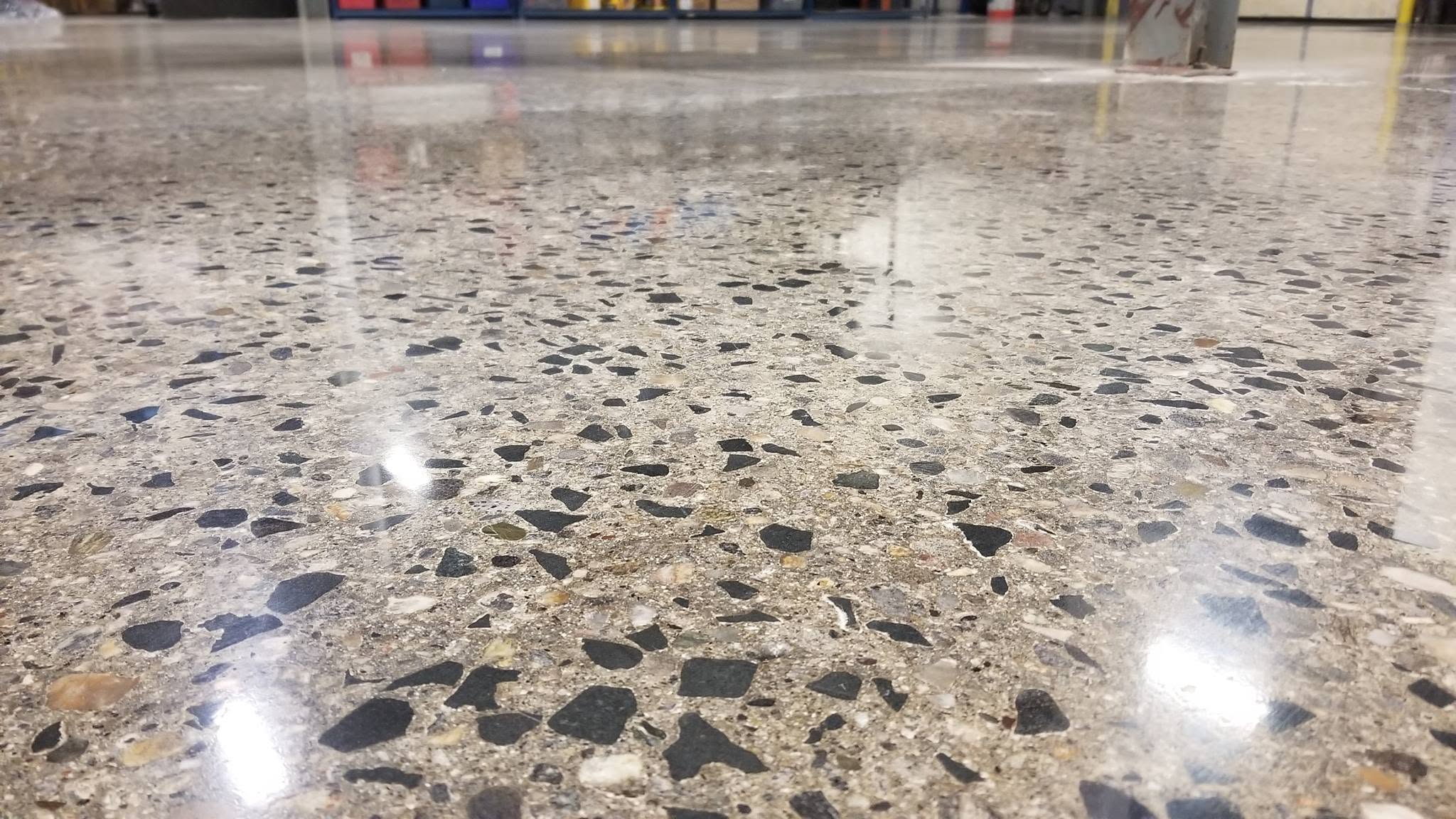
Grinding exposes the natural stone aggregate beneath the surface, while additional polishing develops the desired sheen, from subtle satin to highly reflective.

That appearance is particularly appealing in commercial interiors where the floor contributes to the overall design.

Making use of an existing investment

When it's in suitable condition, polishing allows existing material to serve as the finished floor rather than installing another flooring system over it.

That doesn't automatically make polishing the least expensive option. But it does make it worth considering before committing to a replacement or coating project.

How Does Concrete Polishing and Grinding Work?

Think of the difference between a rough stone and a polished one. Concrete contractors achieve a similar transformation with heavy grinding machines and progressively finer diamond abrasives. Here is what happens between the first pass and the final finish.

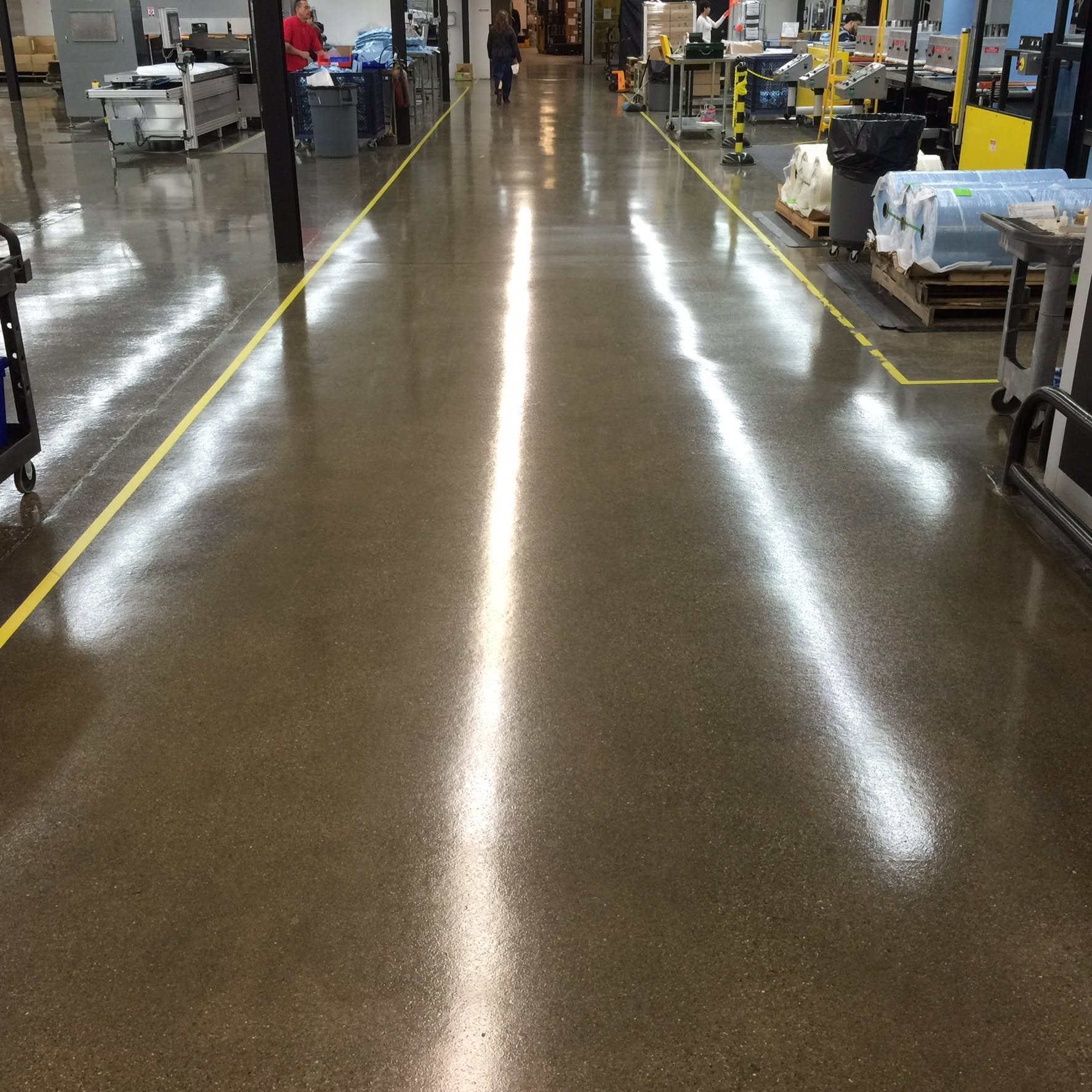
Industrial polished concrete flooring
1

Discover what's beneath the surface

The first question isn't how shiny the floor should be. It's what condition the concrete is in.

An old warehouse floor might conceal layers of paint or adhesive left behind from previous uses. Earlier crack repairs and variations in concrete hardness also influence the work.

Before beginning, the contractor examines the slab and determines how much material needs to be removed.

2

Grind away the worn surface

This is where the transformation begins.

Large concrete grinders equipped with diamond tooling work across the floor, removing material from the upper surface.

Diamond abrasives are used because concrete is hard and contains mineral aggregates that ordinary abrasives would struggle to cut efficiently.

The first grinding passes remove surface irregularities and, where specified, expose aggregate beneath the cement paste.

Think of terrazzo flooring, where small stones are visible within the finished surface. Polished concrete sometimes achieves a similar exposed-aggregate appearance, depending on the original slab.

The contractor controls how much aggregate is exposed by selecting the grinding approach and depth.

3

Strengthen the surface with a densifier

Concrete contains microscopic pores and a network of hydration products formed as cement reacts with water.

During many polishing projects, a chemical densifier is applied to the concrete.

Common silicate-based densifiers react with available calcium hydroxide in cement paste, forming additional calcium silicate hydrate that contributes to a denser, more abrasion-resistant surface.

4

Turn ground concrete into polished concrete

After the initial grinding and other required treatments, the contractor continues refining the floor with progressively finer abrasives.

The surface begins to change.

Coarse grinding marks become less visible. The concrete develops a smoother appearance. With additional refinement, reflected light becomes more distinct.

The process resembles the way a rough stone gradually develops a polished surface as finer abrasives remove the scratches left by earlier steps.

This is also why the final appearance depends on the complete polishing sequence, not simply the last pass with a machine.

5

Protect the finished surface

Some polishing systems include a stain-resistant guard or protective treatment.

These products help limit penetration of certain spills and simplify routine maintenance. They do not make the concrete immune to chemicals or eliminate the need for prompt cleanup.

The appropriate treatment depends on how the facility will use the floor.

Why does that matter?

In a warehouse where concrete dust accumulates on equipment or stored goods, improving abrasion resistance helps address certain types of surface dusting.

Densification isn't a structural repair; its role is to improve the surface within a properly designed polishing system.

What happens to all the dust during grinding?

Without proper controls, grinding concrete generates substantial airborne dust.

Professional concrete grinding equipment often uses dust-extraction systems designed to capture particles near the source. Additional exposure controls may be required for the work.

This is particularly important in occupied buildings, where nearby employees or sensitive operations must be protected.

Is concrete polishing possible without shutting down the entire facility?

For some commercial properties, the biggest concern isn't the polishing process itself. It's whether operations must stop while the work takes place.

Imagine a distribution center that needs to keep shipping orders throughout the week.

Instead of closing the entire building, a contractor might divide the project into work zones. One section is temporarily taken out of service while other areas continue operating.

Whether this is feasible depends on the building layout and the ability to safely separate the work from normal operations.

Planning these details before installation makes a meaningful difference to the project's schedule.

Is an Existing Warehouse or Industrial Concrete Floor Suitable for Polishing?

A worn-looking concrete floor isn't necessarily a worn-out floor.

Some older slabs retain years of useful service beneath discoloration or previous coatings. Others have damage that extends deeper than polishing addresses.

The challenge is distinguishing between cosmetic wear and problems that affect the concrete itself.

What will the existing concrete reveal?

Explore three common conditions that influence the finished result.

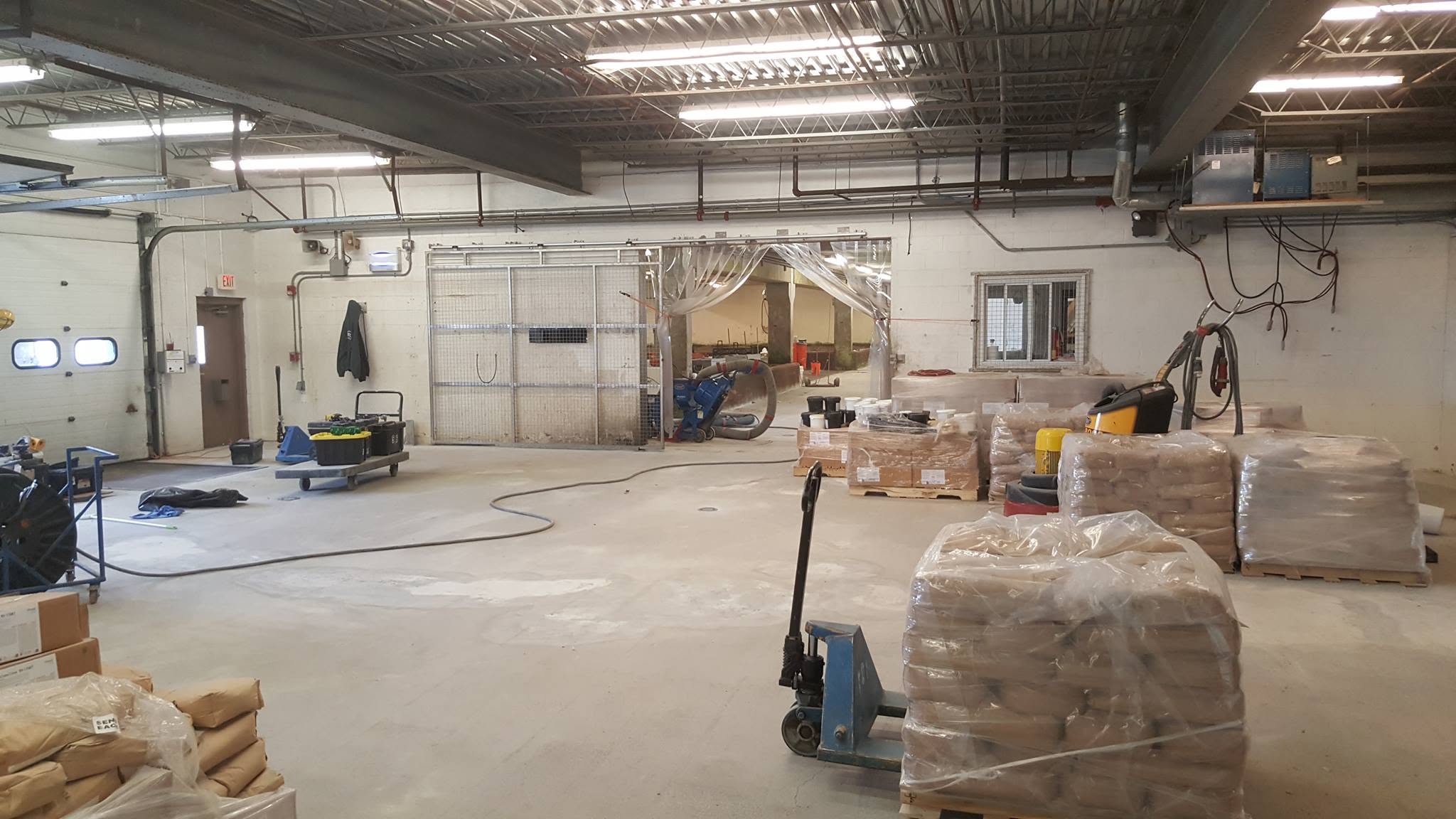
01What happens when an old epoxy coating is removed?

Removing an aging epoxy coating sometimes reveals a very different floor underneath.

Removing the coating exposes patches from previous equipment installations or discoloration that penetrated the concrete. Areas that looked uniform beneath the coating often look different once exposed.

Those discoveries do not automatically rule out polishing.

It does mean the owner should understand that polishing reveals the character of the existing concrete rather than covering it.

For a warehouse, those variations may be perfectly acceptable. In a showroom where the floor is part of the visual design, they may matter much more.

02What about cracks and previous repairs?

Consider a concrete slab with a crack that was repaired years ago.

Even a sound repair sometimes stands out against the surrounding concrete after polishing.

Some owners appreciate the character of an older floor. Others want a consistent appearance.

The key is knowing which result is realistic before choosing the finish.

Active structural movement is a separate concern and cannot be corrected by polishing.

03Why do some concrete floors constantly produce dust?

If you've ever swept a concrete warehouse floor only to find a fine gray powder returning shortly afterward, you've seen surface dusting firsthand.

This problem sometimes develops when the upper concrete surface is weak or deteriorates under abrasion.

Forklift wheels and repeated traffic continue wearing away the surface, releasing fine particles.

On otherwise suitable concrete, grinding and densification address certain surface-dusting problems. Deeper deterioration, however, calls for more extensive repairs.

What Are the Different Polished Concrete Finish Levels?

Here's something that surprises many property owners: polished concrete doesn't have to be shiny.

In fact, two polished concrete floors often look completely different even when contractors use similar equipment.

One might have a subtle, satin-like appearance. Another might reveal large stones beneath the surface and reflect the overhead lighting.

To understand the options, it helps to separate two decisions: how much aggregate you want to see and how reflective you want the surface to become.

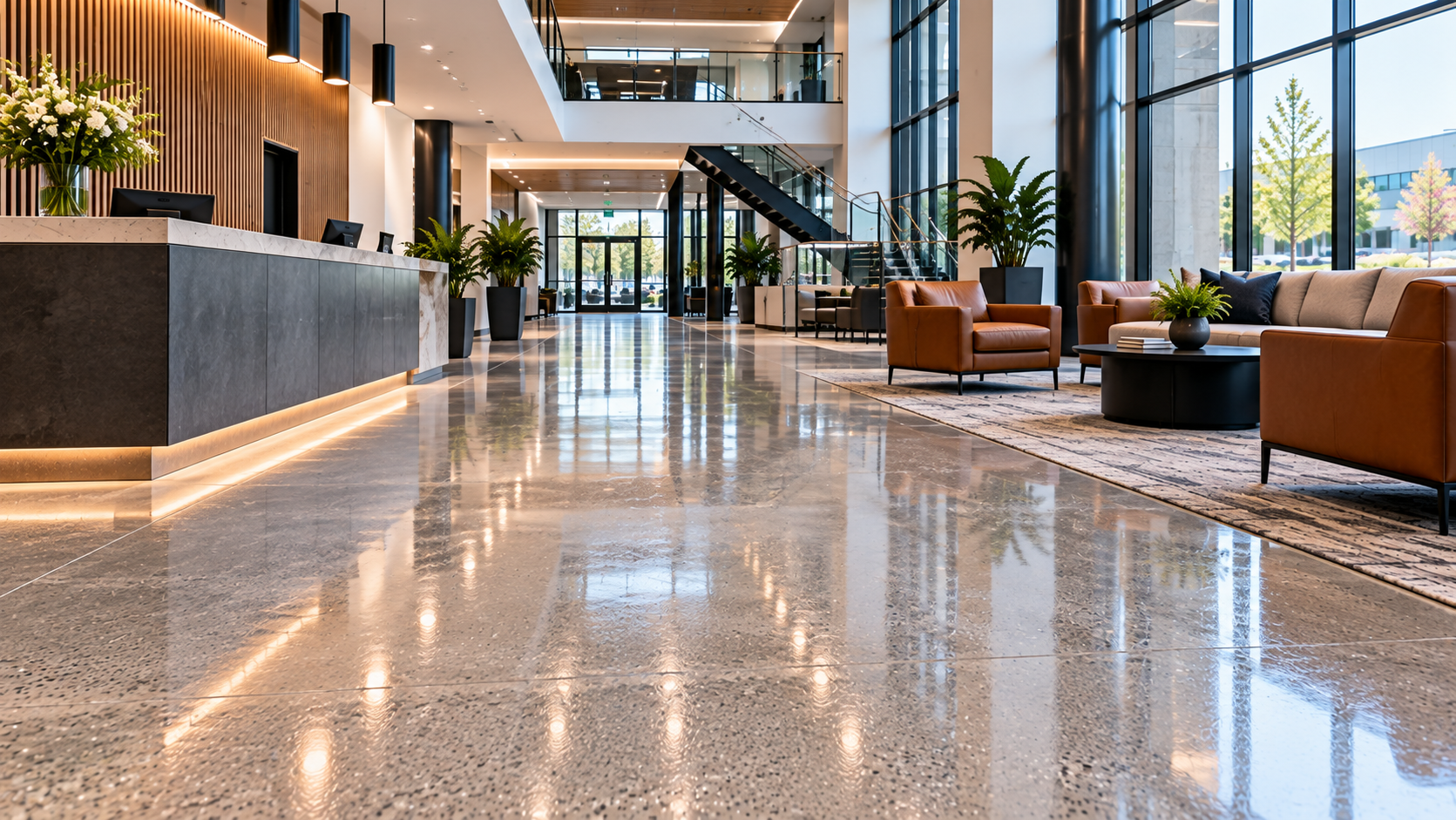
Polished concrete in a commercial showroom

Aggregate exposure: What's hiding inside the concrete?

Concrete is made from cementitious materials, water and aggregates such as sand and stone.

When concrete is placed and finished, the larger aggregate is often concealed beneath the upper cement paste.

CreamMinimal aggregate exposure
Salt-and-pepperFine speckled aggregate
MediumMore underlying stone visible
LargeDeeper grinding reveals larger stones

Grinding removes some of that upper material, revealing what's underneath.

The amount of exposed aggregate dramatically changes the appearance of the floor.

A cream finish preserves more of the original concrete's surface character. Deeper grinding reveals a decorative, stone-like appearance.

However, the contractor cannot choose the size or color of the stones already inside an existing slab. Those characteristics were determined when the concrete was originally placed.

Gloss levels: From subtle satin to reflective polish

Once the desired aggregate exposure is established, the polishing process determines how refined the surface becomes.

A lower-sheen finish has a restrained appearance, while additional polishing develops greater reflective clarity.

Flat or groundLittle visible reflection
Satin or honedSoft sheen
PolishedNoticeable reflection
Highly polishedGreater reflective clarity

These descriptions illustrate the visual differences. Formal specifications should use the appropriate industry classification and agreed acceptance criteria.

A more reflective finish suits the design goals of some retail showrooms, while a warehouse owner might prefer a restrained sheen.

How Much Does Commercial Concrete Polishing Cost?

ILLUSTRATIVE EXAMPLE · SAME FLOOR AREA
Warehouse A20,000 sq ft · Exposed concrete in relatively good condition
Warehouse B20,000 sq ft · Peeling epoxy, patches and adhesive residue

Equal square footage does not mean equal preparation work. These are hypothetical examples, not project estimates.

What determines the cost of concrete polishing?

Surface preparation is often a major factor. Removing an old coating adds work before polishing begins, as do repairs to damaged areas.

The finish you choose also influences the scope. Exposing large aggregate typically requires deeper grinding than a finish that preserves more of the original concrete surface.

Building access also matters. A wide-open warehouse provides different working conditions from a facility filled with equipment that must remain in place.

And if the business must remain operational, the contractor may need to complete the work in stages rather than polish the entire floor at once.

Finished polished concrete floor in a commercial warehouse

Does polishing offer better value than a coating?

Not always. Polishing avoids a separate resinous layer, but extensive repairs or deep grinding change the economics. A coating may be the better investment when the facility needs performance that exposed concrete does not provide. Compare the systems against the actual operating requirements, not installation price alone.

What should you look for in a concrete polishing estimate?

Before comparing prices, make sure you're comparing the same work.

A proposal should explain what happens to existing coatings and damaged areas. It should describe the finish being provided and identify any work that isn't included.

Ask whether the contractor has accounted for the building's operating schedule.

A proposal that looks less expensive may simply leave out preparation or repairs that another contractor has already included.

The best estimate is one that makes the scope clear enough for you to understand what you're buying.

Concrete Polishing vs. Epoxy: Which Is Better for Commercial Floors?

The decision between polished concrete and epoxy becomes clearer when you look at how the building is used.

A distribution warehouse may want a low-maintenance exposed-concrete finish.

A manufacturing plant exposed to process chemicals may need a protective resinous system instead.

The buildings start with the same material, yet their operating conditions lead to different choices.

For the warehouse, polished concrete could be worth considering. For the manufacturing plant, a properly specified epoxy or another resinous flooring system may provide protection that polished concrete cannot.

The distinction is fundamental:

Polishing improves the existing concrete surface. Epoxy adds a protective resinous layer over prepared concrete.

How do polished concrete and epoxy compare?

ConsiderationPolished concreteEpoxy flooring
How it worksMechanically refines the existing concreteCreates an applied resinous flooring surface
AppearanceNatural concrete with selected aggregate exposure and sheenAvailable in a range of colors and finishes
Chemical resistanceLimited, even with certain protective treatmentsDepends on the selected formulation and exposure
MaintenanceRegular cleaning with compatible equipment and productsRequirements depend on the system and texture
Surface repairsPatches may remain visibleSelected repairs are concealed beneath the coating
Best suited forSuitable slabs where exposed concrete meets operational needsSpaces requiring particular coating characteristics
EXPOSED CONCRETE

Why choose polished concrete instead of epoxy?

One advantage is that there's no separate epoxy layer to peel or delaminate.

Polished concrete is not immune to damage. The underlying slab still deteriorates under some conditions, and the finished surface requires maintenance.

For a facility with sound concrete and compatible operating requirements, polishing eliminates the need for a separate resinous coating.

RESINOUS FLOOR SYSTEM

When does epoxy make more sense?

Suppose a production area is regularly exposed to substances that damage concrete.

In that situation, the floor needs more than a refined appearance. It needs a system selected for the actual exposure.

An appropriately specified epoxy coating may provide the required resistance. The contractor should evaluate the chemicals involved, how long they remain on the floor and the cleaning procedures used.

Epoxy also offers a more uniform colored appearance when the existing concrete has extensive patches or visual inconsistencies.

Explore epoxy and resinous flooring

What about urethane cement?

There are industrial environments where even a conventional epoxy system may not be the best option.

Consider a food-processing area that undergoes frequent hot-water washdowns. Temperature changes and demanding sanitation procedures place particular demands on the flooring.

Certain urethane cement systems are designed for these types of environments.

The appropriate system depends on the operating conditions and product specifications, but the example illustrates why industrial flooring decisions should begin with what happens inside the building.

Explore urethane flooring systems

How Do You Maintain Polished Concrete Floors?

Picture a busy warehouse aisle where forklifts travel the same route hundreds of times during a workweek.

Every wheel carries some grit across the floor. Over time, that abrasive material wears at the polished surface, particularly along heavily traveled paths.

This is why the maintenance of polished concrete begins with something surprisingly simple: keeping abrasive dirt off the floor.

What does daily maintenance involve?

For many commercial facilities, regular dust removal is the foundation of a good maintenance program.

For larger areas, an automatic scrubber makes cleaning more practical when its pads and cleaning products are compatible with the installed finish.

The choice of cleaner matters. Aggressive or incompatible products affect the floor's appearance and may damage protective treatments.

The contractor should provide maintenance recommendations specific to the polishing system.
Industrial polished concrete floor surface

Does polished concrete need to be resealed?

Not all polished concrete floors have the same protective treatments.

Some systems use a stain guard to help reduce the penetration of certain spills. These treatments may need renewal as part of the maintenance program.

It's worth asking the contractor exactly what products were applied.

Knowing that information makes it easier to select compatible cleaning products and understand what maintenance may be required later.

What happens when a polished floor loses its shine?

In high-traffic areas, the finish may gradually become less reflective.

That doesn't necessarily mean the floor has failed.

Depending on the condition of the concrete, the surface may be refreshed through appropriate maintenance procedures or additional mechanical refinement.

The maintenance plan should reflect the amount of traffic the floor receives.

Where Does Commercial Concrete Polishing Work Best?

Polishing serves different purposes depending on the building.

In a showroom, appearance may lead the decision. In a warehouse, cleaning and traffic patterns may matter more.

Polished concrete in a public-facing commercial space
01

Warehouses and distribution centers

In a warehouse, the floor is part of the daily operation.

Forklifts travel established routes, pallets are moved across loading areas, and cleaning crews work around ongoing activity.

A suitable polished concrete floor provides a refined surface without requiring a separate coating.

However, forklift traffic introduces another issue that deserves attention: concrete joints.

Repeated wheel impacts damage joint edges over time, especially when the joints are already deteriorating. Polishing the surrounding concrete doesn't eliminate that problem.

Joint repairs and maintenance may need to be addressed as part of the overall flooring project.

02

Manufacturing facilities

For manufacturing facilities, the most important question is what happens on the floor during production.

A plant assembling dry goods may have relatively straightforward flooring requirements. A facility using aggressive chemicals or conducting frequent washdowns may need a specialized protective system.

That distinction is why polished concrete should be evaluated against the actual production process rather than selected solely for its appearance.

03

Retail stores and showrooms

In retail environments, the floor often becomes part of the design.

Polished concrete creates a natural appearance that suits many modern commercial interiors.

Depending on the slab, grinding may reveal aggregate that gives the surface additional visual character.

A showroom owner might choose a more reflective finish, while another business may prefer a subtle satin appearance.

04

Offices and commercial interiors

For offices, polishing may offer an alternative to installing a separate floor covering.

The decision should consider more than appearance. Hard flooring surfaces influence how sound behaves in a space, so acoustics and occupant comfort also matter.

05

Aircraft hangars and specialized industrial buildings

Hangars are another example of why flooring selection requires an understanding of the work performed in the building.

A space used primarily for aircraft storage may have different requirements from one where maintenance activities expose the floor to aviation fluids or chemicals.

Where chemical resistance is essential, a suitable protective coating may be preferable.

When Is Concrete Polishing the Wrong Choice?

Concrete polishing transforms the appearance of a suitable slab, but surface grinding does not solve every underlying problem.

Understanding those limitations before starting a project helps prevent an expensive mistake.

01

Does polishing solve a moisture problem?

No.

If moisture is moving through a concrete slab, polishing does not stop that movement.

Imagine a floor where moisture-related problems have already affected an existing coating. Removing the coating and polishing the concrete may change the type of floor finish, but it does not eliminate the underlying moisture condition.

The source and significance of the moisture need to be understood before deciding how to proceed.

02

What if the concrete is structurally damaged?

A polishing machine works on the surface. It cannot repair a slab that is moving or structurally unsound.

Major cracks and deterioration may require repair or further investigation before any flooring finish is selected.

03

What if the floor is exposed to chemicals?

Concrete is vulnerable to certain chemical exposures, particularly acids.

A polished surface may have a protective treatment, but that doesn't make it equivalent to a chemical-resistant industrial flooring system.

If spills are part of normal operations, the flooring selection should be based on the substances involved and the required level of protection.

04

Is polished concrete suitable for wet processing areas?

Not automatically.

In areas where water is frequently present, slip resistance becomes an important consideration.

Some operations may also require a seamless flooring system or specialized drainage details.

The finished floor needs to meet the facility's actual requirements, regardless of how attractive polished concrete may look.

05

What if the slab is heavily stained?

Deep contamination sometimes remains visible even after grinding.

For example, oil that has penetrated concrete over many years may not be completely removed through normal polishing procedures.

If the owner expects a uniform appearance, that limitation should be discussed before installation.

Sometimes the best concrete polishing recommendation is not to polish the floor at all.

How Do You Choose a Commercial Concrete Polishing Contractor?

A polished concrete floor may look straightforward in a photograph. Achieving that result on an existing industrial slab is another matter.

The contractor's experience with commercial concrete conditions makes a meaningful difference.

Questions to ask before signing a contract

Compare the proposed scope, finished appearance and operational plan, not just the price.

01

Ask what the finished floor will actually look like

Suppose you show a contractor a photograph of a polished concrete showroom with large, evenly distributed aggregate.

02

Will your existing slab produce that appearance?

Not necessarily.

The aggregate inside the concrete was determined when the slab was originally placed. The contractor controls the grinding and polishing process, but cannot guarantee that an older floor contains the same stone distribution as the reference photograph.

A knowledgeable contractor should explain what is achievable rather than promise an identical result.

03

Ask about preparation and repairs

Two contractors may propose polishing the same floor but include very different preparation work.

One may account for removing an existing coating and repairing damaged joints. Another may exclude those items.

Before comparing prices, make sure you understand what's included.

04

Ask how the work will affect operations

If the facility needs to remain open, scheduling becomes part of the flooring decision.

Will the contractor divide the project into phases? How will equipment move through the building? Which areas will be unavailable during installation? These questions are particularly important in distribution centers and active manufacturing facilities.

05

Consider a sample area

For appearance-sensitive projects, a representative sample helps establish expectations.

It may reveal how the concrete responds to grinding and whether the desired aggregate exposure is achievable.

A sample does not guarantee perfect consistency across an entire older slab, but it provides useful information before the full project begins.

06

Look for a contractor who explains the alternatives

A contractor who recommends polishing for every floor isn't necessarily helping you make the best decision.

Sometimes epoxy is more appropriate. In other situations, a urethane system or additional concrete repairs may be needed.

What Should New England Property Owners Consider Before Polishing Concrete?

New England's commercial buildings present distinctive challenges for concrete flooring contractors.

An older mill building in Massachusetts may have a concrete slab that has supported several different industrial uses over its lifetime. A distribution center may experience heavy forklift traffic alongside seasonal exposure to road salt and moisture.

These conditions influence both the appearance of polished concrete and the suitability of the flooring system.

Older manufacturing and mill buildings

Older industrial properties often have a history written into their floors.

Previous equipment installations may have left patches in the concrete. Machinery foundations may have been removed, and earlier renovations may have introduced different repair materials.

Removing an old coating often exposes those changes.

For some owners, the variation adds character. For others, particularly those converting an industrial building into a customer-facing space, a more uniform appearance may be important.

Winter road salt and tracked-in moisture

During a New England winter, loading docks and entrances experience repeated exposure to slush and deicing salts.

These materials affect vulnerable concrete surfaces.

A polished floor may be suitable for certain interior areas, but locations exposed to persistent moisture or deicing chemicals deserve closer evaluation.

Loading docks and freeze-thaw exposure

The floor inside a heated warehouse may experience very different conditions from concrete near an open loading dock.

Repeated freezing and thawing contributes to deterioration when susceptible concrete becomes saturated.

Polishing doesn't correct freeze-thaw damage or make unsuitable concrete resistant to those conditions.

For exposed areas, the flooring recommendation should reflect the actual environment.

Frequently Asked Questions About Commercial Concrete Polishing

How long does commercial concrete polishing take?

The schedule depends on the floor area and the preparation required. A relatively open floor with minimal repairs presents different conditions from an occupied facility where work must be completed in stages. A contractor should provide a project-specific schedule after evaluating the site.

Is colored polished concrete an option?

Yes. Some polishing systems incorporate dyes or other coloring treatments to change the appearance of the concrete. The results depend on the products used and how the existing slab accepts the treatment.

Is polished concrete the same as sealed concrete?

No. Sealed concrete typically receives a protective treatment without undergoing the same progressive mechanical refinement used to produce polished concrete. The appearance and performance depend on the system.

Is newly poured concrete suitable for polishing?

Yes, once newly placed concrete has reached the condition required for the specified polishing process. New construction also offers an opportunity to coordinate the desired finish with concrete placement and finishing.

For newly placed slabs, discuss the desired appearance before placement and confirm when the concrete is ready for the specified polishing sequence.

Does polished concrete need wax?

Mechanical polishing develops the finish through abrasion rather than conventional floor wax. Any additional protective products should be maintained according to their manufacturer’s instructions.

Is damaged polished concrete repairable?

Localized damage is sometimes repairable, but patches may remain visible. The repair approach depends on the damage and the required appearance.

Is polishing possible while a business remains open?

Sometimes. A phased project may allow work to proceed in isolated areas while other parts of the building operate. Safe work-zone separation and dust controls are essential.

Scroll to Top